Distance from Earth
—Waiting for ephemeris…
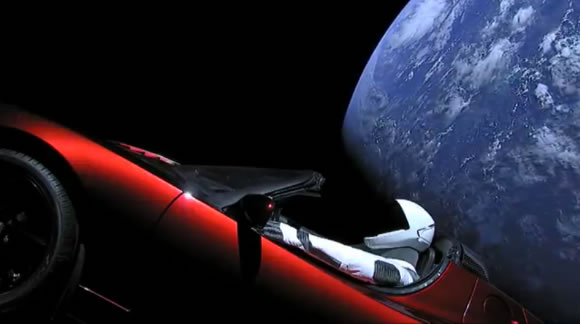
On February 6, 2018, Falcon Heavy carried a Tesla Roadster and its passenger, Starman, into space. Their journey around the Sun continues.
Starts at T−00:10 and autoplays muted when in view. Turn on sound in the player.
Watch on YouTube ↗Starman’s predicted position among the inner planets.
Sun-centered view · markers enlarged for visibility
Open the full orbit explorer →Waiting for ephemeris…
Waiting for ephemeris…
Waiting for ephemeris…
Loading the Roadster’s predicted location…
These are orbit predictions, not a live signal or camera feed. Dates beyond the available ephemeris are explicitly unavailable.
Explore the Roadster’s predicted journey through the inner Solar System.
Axes in millions of miles (M mi). Planet and car markers are enlarged. Curves show approximately one orbit around the selected date. The side view exaggerates height by 6×.
Predicted distance from Earth, Mars, and the Sun over a chosen period.
Nominal encounters published with NASA/JPL Roadster solution #11. These are predictions with growing uncertainty.
| Nominal date (TDB) | Body | Distance | 3σ distance range | Relative speed | Explore |
|---|
TDB is a dynamical time scale, about 69 seconds ahead of UTC at present. “Explore” uses an approximate UTC equivalent. The uncertainty interval does not include every possible unmodeled force. No listed encounter is a predicted impact.
Geometric direction from the center of Earth, using the date selected below.
This is a geometric geocentric direction. It does not include light-time correction, stellar aberration, atmospheric refraction, or your local horizon. It is an educational orientation, not a telescope pointing solution or a visibility forecast.
The current JPL trajectory ends at the start of 2090. This copy carries a saved dataset covering , and checks JPL directly for updated predictions while you visit.
Planetary gravity changes the Roadster’s orbit over time. Close encounters make distant forecasts increasingly uncertain. A static two-body orbit cannot reproduce that behavior, so this tracker uses JPL’s numerical trajectory instead.
When the data ends, the tracker displays “unavailable.” It does not continue an old ellipse indefinitely or silently freeze the car at the final known point.
Explore the available future →Falcon Heavy’s demonstration flight lifted off from Kennedy Space Center on February 6, 2018 at 20:45 UTC. The payload was a Tesla Roadster with a mannequin in a spacesuit, nicknamed Starman.
After an initial period in Earth orbit, the upper stage sent the payload into a heliocentric orbit. The vehicle now travels around the Sun, crossing the range of distances occupied by Earth and Mars.
Watch SpaceX’s Falcon Heavy test flight ↗The clock is live, but the positions are predicted from NASA/JPL Horizons state vectors. The Roadster is not transmitting telemetry to this website.
Yes. The tracker’s data, layout, and photograph are served by this copy. New ephemerides are requested from JPL directly. The standalone HTML also works from its saved dataset without a network connection.
Positions use cubic Hermite interpolation of JPL position and velocity vectors. The saved fallback has two-day samples; refreshed data has daily samples. Numerical interpolation error is separate from, and usually much smaller than, uncertainty in the Roadster’s actual trajectory. This is an educational tracker.
“Toward” and “away” measure the change in distance along the line between two objects. Orbital speed is the Roadster’s full velocity relative to the Sun. Earth and Mars move too.
The photograph is from launch day. There is no live camera feed in this copy. The orbit plots are simulations using predicted positions.
The current JPL solution does not supply a trajectory beyond the start of 2090. A future solution may extend it, but no extension is promised. This copy refuses to extrapolate beyond its valid samples.
Music counters divide elapsed time since launch by assumed track lengths (5:15 and 3:55). The approximate orbit count uses a fixed 557-day reference period. Distance traveled integrates heliocentric speed from the first saved sample, February 8, 2018. These are illustrative counters, not operational measurements.
An independent recreation of the Starman tracking experience, inspired by Where is Roadster, created by Ben Pearson / Old Ham Media. This copy is not operated by, endorsed by, or affiliated with that site, SpaceX, Tesla, NASA, or JPL.
Current distances and speeds, elapsed-time counters, an interactive orbit simulation, distance plots and CSV exports, JPL close approaches, and a geometric sky direction. Other-mission links open official mission pages. The original’s shopping, donation, translations, and mission-planning systems are not reproduced.
Future reliability depends on continued hosting and the availability of JPL’s trajectory. The saved data protects against outages and the loss of the original website, but it cannot supply new observations or guarantee a scientifically accurate position indefinitely.